
AgriMotion Engineering
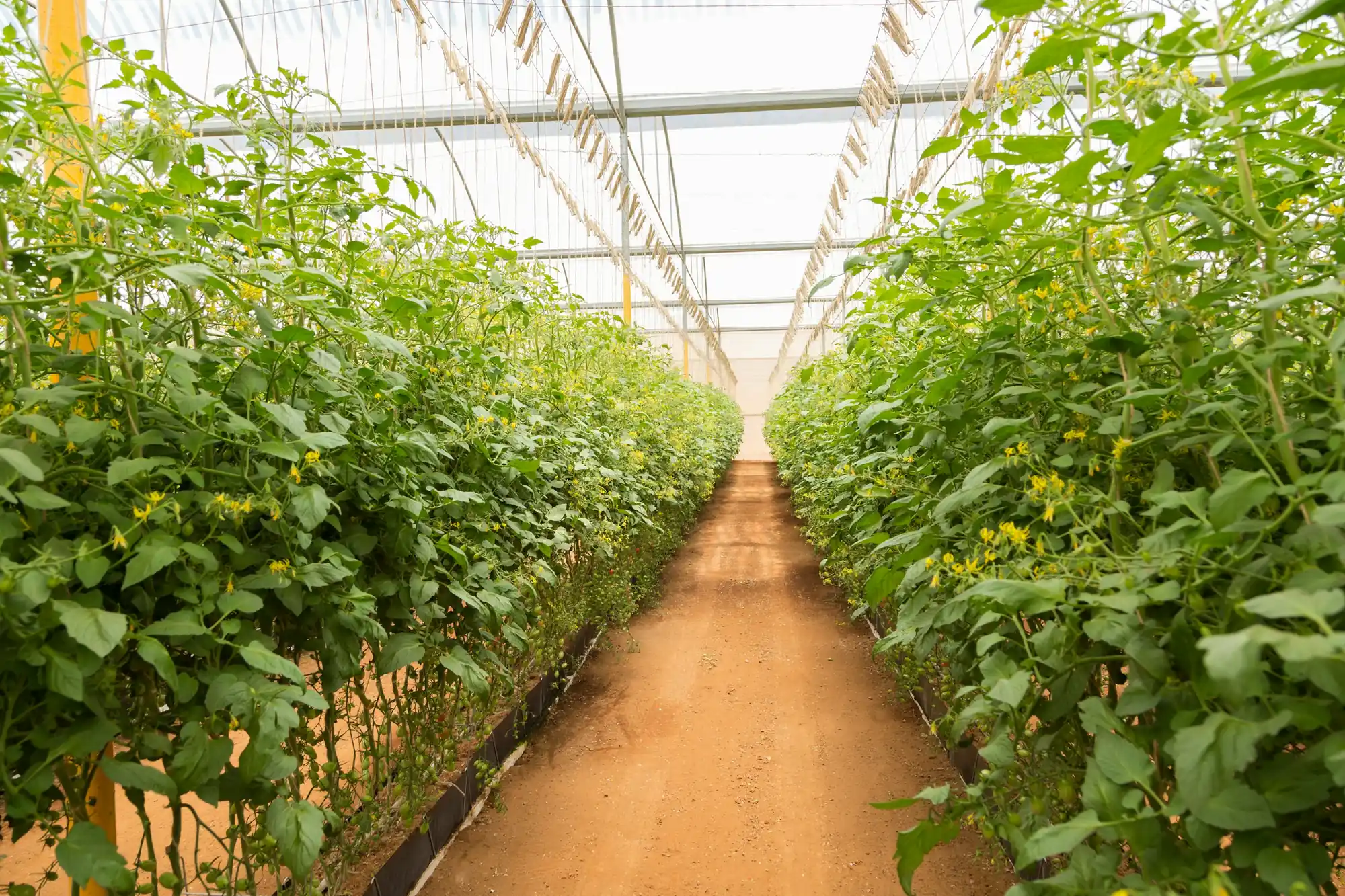
    Polyhouse beside open vegetable fields
    Protected Cultivation

    Polyhouse Resource Center: Design, Cost, Subsidy & Operations

    Everything growers, FPOs and agribusinesses need to plan, build and run a profitable naturally-ventilated or fan-pad polyhouse in India — based on AgriMotion field projects.

    By Updated
    ₹935–1,250
    ₹/sqm NVPH benchmark
    50%
    MIDH assistance on cost norm
    2,500 sqm
    MIDH limit per beneficiary
    3 guides
    + checklist and 3 FAQs
    01

    NVPH vs Fan-Pad Polyhouse: Which One Should You Build?

    Naturally-ventilated polyhouses suit most Indian climates and high-value vegetables; fan-pad evaporative-cooled houses are needed where ambient summer temperatures exceed 38°C for sensitive crops like Dutch roses, gerbera or imported capsicum varieties.

    A naturally-ventilated polyhouse (NVPH) uses ridge and side vents with insect-net curtains to exchange air passively. Capital cost lands around ₹935–1,050 per sqm for MIDH-approved CPVC tubular structures. Operating cost is essentially zero because there are no fans or pumps running continuously.

    A fan-pad polyhouse adds a cellulose cooling pad wall on one side and exhaust fans on the opposite side. Air is pulled across wet pads, dropping inside temperature 8–12°C below ambient. Capex rises to ₹1,250–1,650 per sqm and electricity becomes a recurring cost (typically 30–60 kWh per 1,000 sqm per day during summer).

    Rule of thumb: capsicum, tomato, cucumber, leafy greens and most Indian flowers do well in a properly designed NVPH up to Pune/Hyderabad climate. Above that latitude band, for premium exotics or year-round Dutch rose, fan-pad pays back through higher yields and rejection-free quality.

    02

    Polyhouse Cost Breakdown — What You Actually Pay Per Sqm

    A turnkey 1-acre (4,000 sqm) NVPH typically lands between ₹37 lakh and ₹50 lakh including structure, cladding, irrigation, fogger and basic crop support.

    The CPVC GI tubular structure (Class B, hot-dip galvanised, 80–120 micron coating) is the single largest line item at around 35–40% of project cost. Use only IS 1239 / IS 4923 compliant tubes — under-spec structures fail in cyclonic winds and disqualify subsidy claims.

    200-micron UV-stabilised 5-layer polyfilm (Ginegar, Politiv or equivalent) lasts 36–48 months. Side curtains use 40-mesh insect-proof net. Aluminium clip-and-spring polyfilm fixing is mandatory for MIDH approval; wooden batten fixing is rejected.

    Irrigation includes a venturi/dosatron fertigation unit, sand-and-screen filtration, 16mm inline drippers at 30cm spacing for vine crops, and overhead foggers for humidity control. Budget 8–12% of project cost here.

    Structure & galvanising
    35–40% of capex
    200-micron polyfilm + nets
    15–18% of capex
    Fertigation + irrigation
    8–12% of capex
    Civil + foundation
    10–12% of capex
    Erection + commissioning
    10–15% of capex
    03

    MIDH & NHB Polyhouse Subsidy — Eligibility and Filing Process

    MIDH (Mission for Integrated Development of Horticulture) pays 50% of the cost norm for protected cultivation on up to 2,500 sqm per beneficiary; the National Horticulture Board funds larger projects above 4,000 sqm at 35% (45% in NE/hilly areas). The two cannot be combined for the same component — the right scheme is chosen per project.

    MIDH is implemented through the state horticulture mission. Under the MIDH Operational Guidelines 2025, the cost norm for a naturally ventilated tubular polyhouse is ₹1,200/sqm up to 500 sqm, ₹1,050/sqm for 500–1,008 sqm and ₹1,000/sqm for 1,008–2,500 sqm; fan & pad is ₹1,800, ₹1,600 and ₹1,500/sqm for the same bands. Assistance is 50% of the cost norm, and the norms are 15% higher in NE & Himalayan states and scheduled areas. The subsidy is released to the beneficiary after joint inspection.

    NHB Scheme 1 (commercial horticulture in protected conditions) is for projects above 4,000 sqm (1,000 sqm in NE states). Since NHB’s Public Circular of 21 August 2026 the subsidy is 35% of eligible project cost (45% in NE, Himalayan and special areas), up to ₹100 lakh per project. NHB requires a bank term loan — the subsidy is released to the bank as back-end credit — and no work may start at site before NHB’s Grant of Clearance (GoC).

    Documents needed: land record (khasra/khatauni), DPR with quotation, soil and water test, GST registration, PAN, Aadhaar, bank consent letter. AgriMotion handles end-to-end filing including DPR, site inspection coordination and JIC (Joint Inspection Committee) follow-up.

    Checklist

    Pre-Construction Checklist

    Tick off what’s in hand. Anything still open is where the DPR and the scheme file usually stall.

    0/8ready
    Questions

    Frequently asked questions.

    Short answers on polyhouse. The full reasoning is in the guides above.

    What is the minimum land required for a subsidised polyhouse?

    MIDH supports protected cultivation up to 2,500 sqm per beneficiary, on a pro-rata basis for smaller areas. Most banks prefer at least 1,000 sqm (one quarter acre) for a viable project. NHB’s protected-cultivation component is for projects above 4,000 sqm (1,000 sqm in NE states).

    How long does a polyhouse last?

    The galvanised structure has a 15–20 year design life. The 200-micron polyfilm is replaced every 3–4 years and the insect net every 4–5 years. Most growers recover capital within 3–4 cropping cycles when growing high-value vegetables or flowers.

    Can I run a polyhouse on solar power?

    Yes. A 1-acre NVPH needs about 2–3 kW for fertigation pump and foggers. A 1-acre fan-pad house needs 10–15 kW. The irrigation pump can be solarised under PM-KUSUM — Component B for a standalone off-grid solar pump, Component C for an existing grid-connected pump; fan and pad loads are sized as a separate rooftop or ground-mount system.

    Protected Cultivation

    Get a polyhouse DPR & subsidy estimate

    A crop, a capacity and a location are enough to begin. Share drawings or site photos on WhatsApp if you have them.

    • An engineer calls backUsually the same working day — someone who can talk loads, layouts and schemes.
    • An indicative estimateCapex range, scheme fit and next steps, before any paid DPR work.
    • No obligationYour details are used only to reply to this enquiry.
    Your details
    Your project

    No spam. Indicative estimate only — final quotation depends on site condition, specifications and current material rates.